How to Choose the Right EV Charging Cable: A Complete Guide for Electric Vehicle Owners
The rapid growth of electric vehicles (EVs) has transformed the automotive industry and accelerated the development of charging infrastructure worldwide. As more consumers and businesses adopt electric mobility, understanding the components involved in charging becomes increasingly important. Among these components, the EV charging cable is one of the most critical yet often overlooked elements.
While EV charging stations and vehicle batteries frequently receive the most attention, the charging cable serves as the essential connection that transfers power safely and efficiently from the charger to the vehicle. Selecting the right cable can significantly impact charging speed, convenience, safety, and long-term reliability.
Whether you are a first-time EV owner, fleet operator, or commercial charging station installer, choosing the correct EV charging cable is crucial for maximizing charging performance and protecting your investment. This guide explores the different types of EV charging cables, connector standards, technical specifications, and key factors to consider before making a purchase.
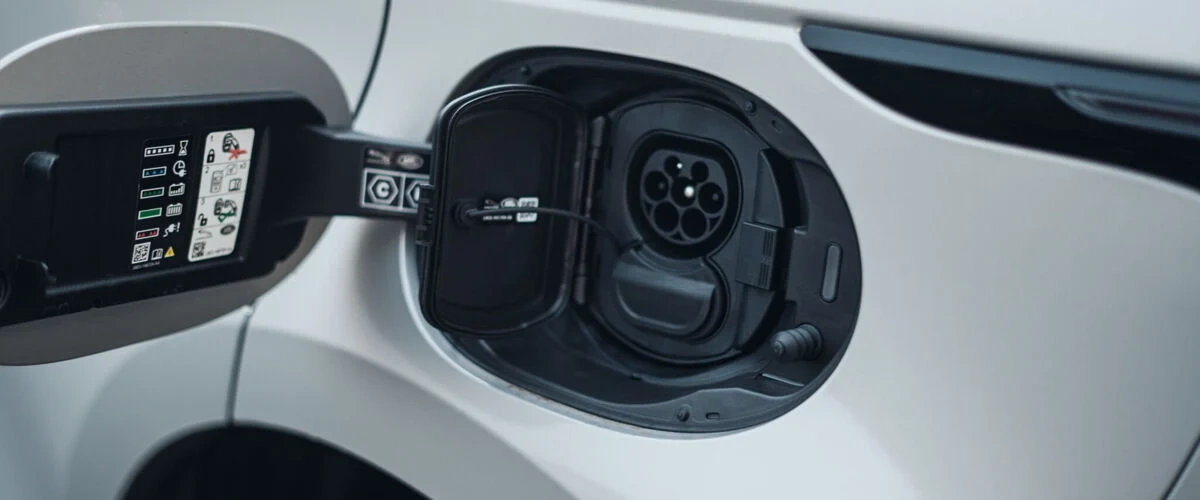
An EV charging cable acts as the communication and power transfer link between an electric vehicle and a charging point. It delivers electricity from the charging source to the vehicle's battery management system while ensuring safe and controlled charging.
Modern EV charging cables are designed with advanced safety features, including:
- Temperature monitoring
- Overcurrent protection
- Insulation against electrical faults
- Weather-resistant construction
- Secure locking mechanisms
A high-quality charging cable ensures stable power transmission, minimizes energy losses, and reduces the risk of overheating. Conversely, using an incompatible or low-quality cable can lead to slower charging speeds, charging interruptions, equipment damage, or even safety hazards.
As EV technology continues to evolve, selecting a charging cable that meets both current and future charging requirements becomes increasingly important.
Many EV owners focus primarily on charger power ratings without realizing that the charging cable itself can become a limiting factor.
The right charging cable provides several advantages:
A properly rated cable allows the vehicle to charge at its maximum supported speed. An undersized cable may restrict power delivery, increasing charging times significantly.
Certified charging cables undergo rigorous testing to ensure safe operation under various environmental and electrical conditions.
Premium cables feature robust insulation materials, UV resistance, and weatherproof construction, making them suitable for long-term indoor and outdoor use.
Choosing the appropriate cable length and connector type improves charging accessibility and ease of use.
As charging technology advances, selecting a higher-rated cable can help accommodate future vehicle upgrades and charging infrastructure developments.
Before purchasing an EV charging cable, it is important to understand the charging standards used in different regions and vehicle models.
Several connector systems are currently used around the world, with each serving specific charging applications.
The most common connector categories include:
- Type 1 connectors
- Type 2 connectors
- CCS connectors
- CHAdeMO connectors
- Tesla charging connectors
Understanding these standards helps ensure compatibility between your vehicle and charging station.
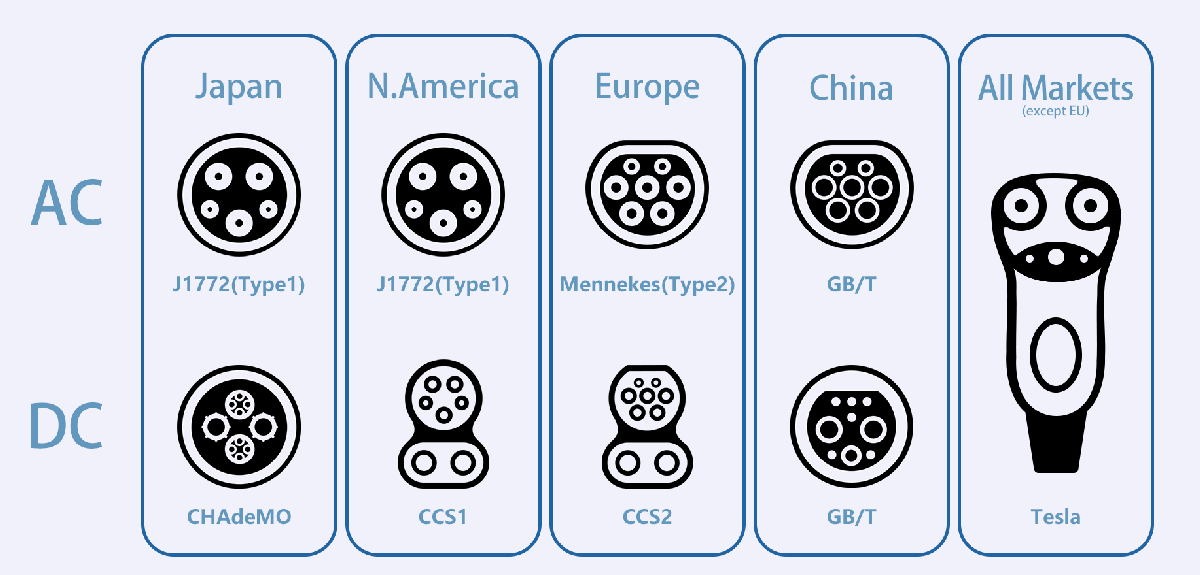
Type 1 connectors, also known as SAE J1772 connectors, are commonly used in North America and some Asian markets.
Key Characteristics
- Five-pin design
- Supports single-phase AC charging
- Charging power typically ranges from 3.7 kW to 7.4 kW
- Lightweight and compact design
- Common in older EV models
Type 1 connectors feature a latch mechanism but generally do not provide the same integrated locking capabilities found in Type 2 systems.
Many early electric vehicles, including several Japanese and American models, were equipped with Type 1 charging ports.
Advantages
- Widely available in North America
- Simple and reliable design
- Cost-effective charging solution
Limitations
- Limited charging speed
- Single-phase charging only
- Less common in newer European vehicles
Type 2 connectors, often referred to as Mennekes connectors, have become the standard charging interface throughout Europe and many other international markets.
Key Characteristics
- Seven-pin configuration
- Supports both single-phase and three-phase charging
- Power delivery up to 22 kW for AC charging
- Secure locking mechanism
- Broad compatibility with modern EVs
The Type 2 connector offers greater flexibility and charging capacity than Type 1 systems, making it the preferred choice for residential, workplace, and public charging installations.
Advantages
- Higher charging speeds
- Three-phase charging support
- Enhanced safety through connector locking
- Widely adopted across Europe
Limitations
- Slightly larger connector size
- May require adapters for Type 1 vehicles
As electric vehicle adoption continues to expand globally, Type 2 connectors are increasingly becoming the universal standard for AC charging applications.
Alternating Current (AC) charging remains the most common charging method for electric vehicles.
When using AC charging, electricity flows from the grid to the vehicle through the charging cable. The vehicle's onboard charger then converts AC electricity into Direct Current (DC) to charge the battery.
Typical AC Charging Levels
Slow Charging
- 2.3 kW to 3.7 kW
- Suitable for overnight home charging
Fast AC Charging
- 7.4 kW to 22 kW
Common in residential and workplace charging installations
Benefits of AC Charging
- Lower installation costs
- Reduced strain on electrical infrastructure
- Ideal for daily charging needs
- Broad compatibility with EV models
Because AC charging relies on the vehicle's onboard charger, charging speeds may vary depending on vehicle specifications even when using the same charging station.
Direct Current (DC) charging delivers electricity directly to the battery, bypassing the vehicle's onboard charger.
This approach enables significantly faster charging speeds.
Typical DC Charging Power Levels
- 50 kW
- 100 kW
- 150 kW
- 250 kW
- 350 kW
Modern ultra-fast charging stations can recharge many EV batteries from 10% to 80% in less than 30 minutes.
Advantages of DC Charging
- Rapid charging capability
- Ideal for long-distance travel
- Reduced downtime
- Supports commercial fleet operations
Limitations
- Higher infrastructure costs
- Larger and heavier cables
- Increased thermal management requirements
DC charging cables are generally attached permanently to charging stations due to their size, cooling systems, and high-current design.
Combined Charging System (CCS) has emerged as one of the most widely adopted DC fast-charging standards globally.
CCS combines AC and DC charging capabilities into a single vehicle charging port.
CCS1
Primarily used in:
- United States
- Canada
- South Korea
CCS2
Commonly used in:
- Europe
- Australia
- New Zealand
- Many developing EV markets
Benefits of CCS
- Supports ultra-fast charging
- Single charging port for AC and DC charging
- Extensive public charging infrastructure
- Strong support from major automakers
Many modern EVs now use CCS as their primary charging standard due to its flexibility and scalability.
CHAdeMO is a DC fast-charging standard originally developed in Japan.
The name is derived from the phrase "Charge de Move," reflecting its focus on enabling convenient and rapid charging.
Key Features
- Dedicated DC charging connector
- Strong presence in Japan
- Supports bidirectional charging
- Vehicle-to-grid (V2G) compatibility
Charging Performance
Most CHAdeMO chargers deliver between:
- 50 kW and 100 kW
Newer versions support even higher charging capacities.
Advantages
- Mature and proven technology
- Excellent V2G functionality
- Reliable charging performance
Limitations
- Declining global adoption
- Less charging infrastructure outside Asia
- Larger connector design
Although CCS has gained broader international adoption, CHAdeMO remains important in several markets and vehicle models.
The first step when choosing an EV charging cable is identifying your vehicle's charging port.
Vehicle manufacturers typically specify:
- Connector type
- Maximum charging power
- Supported charging standards
You should never assume compatibility based solely on charger appearance.
Check:
- Vehicle owner's manual
- Manufacturer website
- Charging port labeling
Choosing the correct connector ensures seamless charging and prevents costly compatibility issues.
Cable length is often underestimated but can significantly affect daily charging convenience.
Common cable lengths include:
- 3 meters
- 5 meters
- 7 meters
- 10 meters
Short Cables
Advantages:
- Lightweight
- Easier storage
- Lower cost
Disadvantages:
- Limited reach
- Less flexibility in parking positions
Medium-Length Cables
A 5-meter cable is generally considered the ideal balance.
Benefits include:
- Sufficient reach for most situations
- Manageable weight
- Convenient storage
Long Cables
Advantages:
- Greater flexibility
- Suitable for challenging parking layouts
- Disadvantages:
- Heavier handling
- Increased storage requirements
- Higher purchase cost
Selecting the proper cable length improves convenience while minimizing clutter.
Current rating determines the maximum electrical current a charging cable can safely carry.
Common EV charging cable ratings include:
16 Amp Cables
Suitable for:
- 3.6 kW charging
- Basic residential charging
32 Amp Cables
Suitable for:
- 7.4 kW single-phase charging
- 22 kW three-phase charging
Higher-Rated Cables
Designed for:
- Commercial charging applications
- Future charging requirements
- High-power installations
A cable's current rating should meet or exceed the charging capability of your vehicle and charging station.
Using a higher-rated cable can provide valuable future-proofing benefits.
Another important consideration is whether your charging setup uses single-phase or three-phase electricity.
Single-Phase Charging
Common in residential properties.
Typical charging speeds:
- 3.6 kW
- 7.4 kW
Three-Phase Charging
Common in:
- Commercial facilities
- Public charging stations
- Industrial locations
Charging speeds may reach:
- 11 kW
- 22 kW
If your vehicle and electrical supply support three-phase charging, selecting a compatible cable can significantly reduce charging times.
EV charging cables are often exposed to challenging environmental conditions.
Important durability features include:
- UV-resistant insulation
- Waterproof construction
- Dust protection
- Abrasion resistance
- Flexible low-temperature performance
Look for products with appropriate IP ratings and compliance with international safety standards.
High-quality materials help extend service life and maintain safe operation over many years.
When purchasing an EV charging cable, always verify compliance with recognized safety standards.
Common certifications include:
- CE Certification
- UKCA Certification
- UL Certification
- TÜV Certification
- IEC Compliance Standards
Certified products undergo extensive testing for:
- Electrical safety
- Mechanical durability
- Thermal performance
- Environmental resistance
Avoid unverified products from unknown sources, as they may pose safety risks.
Electric vehicle technology continues to evolve rapidly.
When selecting a charging cable, consider future developments such as:
- Higher charging capacities
- New EV purchases
- Expanded home charging systems
- Commercial charging upgrades
Purchasing a cable with a higher current rating than your current vehicle requires can provide flexibility for future needs.
Future-proofing reduces replacement costs and ensures compatibility with next-generation EVs.
Many EV owners make avoidable mistakes when selecting charging cables.
Buying Based Solely on Price
Cheaper cables may compromise safety, durability, and charging performance.
Ignoring Cable Length
Insufficient reach can create daily inconvenience and limit charging options.
Overlooking Charging Speed Compatibility
An incorrectly rated cable may prevent your vehicle from charging at maximum speed.
Choosing Non-Certified Products
Safety should always be a top priority.
Forgetting Future Requirements
Investing in a slightly higher-rated cable often provides better long-term value.
An EV charging cable is much more than a simple accessory—it is a critical component that directly affects charging speed, safety, convenience, and long-term reliability. Understanding connector standards, charging methods, current ratings, cable lengths, and safety certifications allows EV owners to make informed purchasing decisions.
For most modern electric vehicles, a Type 2 charging cable with a 32A rating and approximately 5 meters of length provides an excellent balance of performance, flexibility, and future compatibility. However, every vehicle and charging environment is unique, making it essential to verify connector type, charging capacity, and installation requirements before purchasing.
As electric mobility continues to expand worldwide, investing in a high-quality EV charging cable ensures dependable charging performance today while preparing for the evolving charging technologies of tomorrow. By selecting the right cable, EV owners can enjoy faster charging, enhanced safety, and a more convenient electric driving experience for years to come.