
Portable EV Chargers vs Wall-Mounted EV Chargers: A Comprehensive Comparison Guide
As electric vehicles (EVs) become increasingly common worldwide, reliable charging solutions are now a necessity rather than a convenience. Whether you're a daily commuter, a road-trip enthusiast, or a fleet operator, choosing the right charger directly affects your vehicle's usability, operating cost, and overall ownership experience. Among the most popular options available today are portable EV chargers and wall-mounted EV chargers. Each offers distinct advantages, technical characteristics, and use-case scenarios, making them suitable for different drivers and environments.
Understanding the differences between these two charging solutions is essential before making a purchasing decision. While both deliver energy to your vehicle safely and efficiently, they differ significantly in power output, installation requirements, cost, convenience, and smart features. This article provides a complete comparison of portable and wall-mounted EV chargers, examining their working principles, performance, benefits, limitations, safety considerations, installation factors, and best-fit applications.
Portable EV chargers are compact charging devices designed for mobility and convenience. Typically lightweight and equipped with standard plugs, they allow users to charge their electric vehicles from various outlets without permanent installation. Many models support multiple voltage options, such as 120V or 240V, and often include interchangeable adapters for different socket standards.
Their plug-and-play design makes them especially useful for travelers, renters, or drivers who do not have access to dedicated charging infrastructure. Because they can be stored in a trunk or storage compartment, portable chargers function as both primary charging solutions and emergency backups.
Key Characteristics
- Compact and lightweight construction
- No installation required
- Compatible with multiple outlets
- Adjustable current settings
- Travel-friendly design
Some advanced portable chargers include digital displays, temperature monitoring, delayed charging timers, and safety protections such as overcurrent, overvoltage, and ground fault detection. These features ensure safe operation even in varied environments.
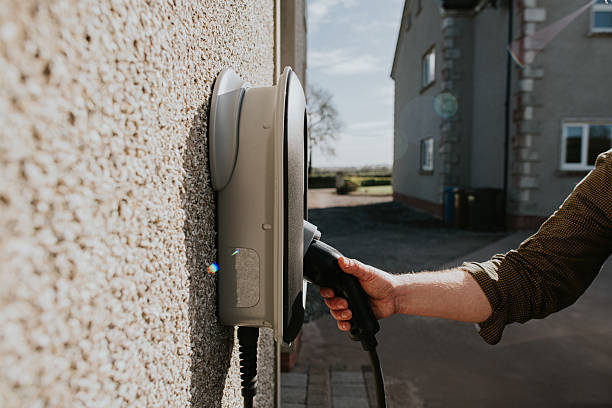
Wall-mounted EV chargers, often referred to as home charging stations, are fixed units installed on walls in garages, parking structures, or outdoor charging areas. Unlike portable chargers, these systems are designed for permanent installation and usually operate at Level 2 charging speeds, delivering significantly higher power.
Most wall-mounted chargers require professional installation because they connect directly to a dedicated electrical circuit. Once installed, they provide consistent, fast, and reliable charging, making them ideal for daily use. Many modern models also include advanced connectivity options such as Wi-Fi, Bluetooth, mobile app integration, and smart energy scheduling.
Typical Features
- High-power output (usually 240V)
- Fixed installation
- Faster charging speeds
- Integrated cable management
- Smart connectivity options
Major charging equipment providers such as ChargePoint and Wallbox manufacture wall-mounted units designed for residential and commercial applications, often integrating software platforms for monitoring usage and optimizing electricity costs.
One of the most significant differences between portable and wall-mounted chargers is charging speed.
Portable chargers typically operate at Level 1 or lower-power Level 2 rates. When plugged into a standard household outlet, they may deliver around 1–2 kW of power, translating to slow charging speeds. This means a full battery recharge can take anywhere from 12 to 30 hours depending on battery size.
Some advanced portable models support 240V outlets, increasing output to 3–7 kW. While this improves performance, it still may not match dedicated wall-mounted stations.
Wall-mounted chargers are usually designed for Level 2 charging, delivering 7–22 kW depending on electrical capacity. At these speeds, most EVs can recharge overnight, typically within 4–8 hours. For drivers who rely on their vehicle daily, this speed advantage is often decisive.
Installation is virtually nonexistent. Users simply plug the device into a compatible outlet and connect it to their vehicle. This simplicity makes portable chargers ideal for temporary residences, shared parking spaces, or locations where permanent installation is not permitted.
Wall-mounted chargers require installation by a qualified electrician. The process may involve:
- Upgrading electrical panels
- Installing dedicated circuits
- Mounting hardware securely
- Ensuring compliance with electrical codes
Although installation increases upfront cost, it ensures safe operation and maximum charging efficiency.
Organizations such as National Electrical Manufacturers Association publish standards that guide safe electrical equipment installation, which many manufacturers follow when designing wall-mounted charging units.
Cost plays a major role when choosing between portable and fixed charging solutions.
- Lower initial purchase price
- No installation expense
- Minimal maintenance
- Higher purchase price
- Professional installation fees
- Potential electrical upgrades
However, wall-mounted chargers can deliver long-term value through faster charging, energy efficiency, and potential smart-grid integration that reduces electricity costs during off-peak hours.
Convenience depends largely on how and where you drive.
- Usable anywhere with power access
- Ideal for road trips
- Useful as backup charging option
- Suitable for renters
- Always ready at home or workplace
- Faster charging times
- Integrated cable storage
- Automated scheduling
Drivers who frequently travel or lack a fixed parking location often prefer portable chargers, while homeowners with dedicated parking typically benefit more from wall-mounted systems.
Both charger types are designed with safety in mind, but their reliability depends on usage conditions.
Portable chargers must withstand varying environments, including temperature fluctuations, moisture, and uneven power sources. High-quality units include protective enclosures, thermal sensors, and waterproof ratings to ensure safe operation.
Wall-mounted chargers, on the other hand, benefit from stable installation conditions. Because they connect to dedicated circuits, they experience fewer electrical fluctuations, reducing wear and improving long-term durability.
Many EV manufacturers, including Tesla and Ford, recommend using certified charging equipment to ensure compatibility and maintain battery warranty conditions.
Smart technology is rapidly transforming EV charging.
Some advanced portable chargers now include:
- LCD status displays
- App connectivity
- Adjustable current levels
- Charging timers
These features provide flexibility but may be limited compared to fixed systems.
Wall-mounted chargers often include advanced digital capabilities:
- Wi-Fi monitoring
- Energy usage tracking
- Remote start/stop control
- Voice assistant integration
- Solar energy synchronization
These capabilities make them particularly attractive for homeowners interested in energy management or renewable integration.
Portable chargers require virtually no dedicated space. They can be stored in a bag, drawer, or vehicle compartment. This is beneficial for urban dwellers with limited storage or shared parking areas.
Wall-mounted chargers require wall space and a suitable electrical connection point. However, modern designs are compact and aesthetically streamlined, allowing installation even in tight garages or parking bays.
Portable chargers generally require minimal maintenance. Users should periodically inspect cables and connectors for wear, dirt, or damage. Cleaning the plug contacts and storing the charger properly can significantly extend its lifespan.
Wall-mounted chargers also need occasional inspection, particularly for cable integrity, mounting stability, and firmware updates if smart features are included. Because they are permanently installed, they may last longer and experience less physical stress than portable units.
Choosing between portable and wall-mounted chargers often depends on lifestyle and charging habits.
- Frequent travel
- No fixed parking location
- Apartment living
- Backup emergency charging
- Daily commuting
- Home garages
- Fleet charging
- Workplace installations
For example, drivers who commute long distances every day benefit from the speed and reliability of a wall-mounted charger, while occasional drivers or travelers may prioritize portability.
Energy efficiency is another important consideration. Wall-mounted chargers typically deliver higher efficiency because they operate on dedicated circuits and optimized voltage levels. This reduces energy loss during charging.
Portable chargers connected to standard outlets may experience slightly higher energy loss due to lower voltage and longer charging times. However, modern designs incorporate advanced circuitry that minimizes inefficiencies and ensures stable current delivery.
For households planning to own multiple electric vehicles, scalability is critical.
Portable chargers are usually designed for single-vehicle use and may not support simultaneous charging. Wall-mounted systems, however, can often be expanded or integrated into multi-charger networks, making them suitable for families, commercial garages, or fleet operators.
Some advanced wall-mounted systems even support load balancing, allowing multiple vehicles to charge simultaneously without overloading the electrical system.
Durability depends on materials, design, and environmental exposure.
Portable chargers must withstand frequent handling, movement, and storage. High-quality units use reinforced cables, impact-resistant housings, and weatherproof connectors.
Wall-mounted chargers are built for long-term stationary use. Their rugged enclosures protect internal electronics from dust, moisture, and temperature changes. Because they are not constantly moved, they often experience less physical stress, contributing to longer service life.
User experience can differ greatly between the two options.
Portable chargers offer simplicity. Plug in, connect, and charge. This straightforward approach appeals to drivers who prefer minimal setup.
Wall-mounted chargers provide a more integrated experience. Many models automatically begin charging when the vehicle is plugged in, track energy consumption, and allow scheduling during low-cost electricity periods. These conveniences enhance everyday usability.
Pros
- Highly portable
- Lower cost
- No installation
- Flexible usage
Cons
- Slower charging
- Limited power output
- Less advanced features
Pros
- Faster charging speeds
- Reliable power delivery
- Smart technology features
- Long-term durability
Cons
- Higher initial cost
- Installation required
- Not portable
Selecting the right charger involves evaluating your driving habits, home infrastructure, budget, and long-term plans. Consider the following questions:
Do you drive long distances daily?
Do you have a private garage or parking space?
Do you travel frequently?
Is fast charging a priority?
Do you plan to own multiple EVs?
If your priority is flexibility and affordability, a portable charger may be the best choice. If speed, convenience, and advanced features matter most, a wall-mounted charger is likely the better investment.
The EV charging industry continues to evolve rapidly. New technologies are emerging that may further blur the distinction between portable and fixed chargers. For instance:
- Portable chargers with higher power outputs
- Wall-mounted chargers with modular detachable designs
- Wireless charging systems
- Solar-integrated home charging stations
- AI-driven energy optimization
As battery technology improves and charging standards evolve, both portable and wall-mounted chargers will become more efficient, intelligent, and user-friendly.
Portable and wall-mounted EV chargers each serve essential roles in the electric mobility ecosystem. Portable chargers excel in flexibility, affordability, and convenience for travel or temporary use. Wall-mounted chargers, meanwhile, provide faster speeds, advanced features, and reliable daily charging for home or commercial environments.
There is no universally superior option—only the solution that best matches your lifestyle and charging needs. Many EV owners ultimately choose to use both: a wall-mounted charger for everyday home charging and a portable charger for emergencies or travel. This combination offers maximum convenience, ensuring that wherever the road leads, a reliable power source is always within reach.
As electric vehicles continue to reshape transportation, understanding charging options empowers drivers to make informed decisions, optimize energy use, and enjoy the full benefits of sustainable mobility.
