EV Charging Standards Battle: NACS vs CCS Connector Comparison
As electric vehicles (EVs) rapidly transform the global transportation landscape, charging infrastructure has become one of the most critical components of the EV ecosystem. Among the many technological developments shaping this industry, the competition between the North American Charging Standard (NACS) and the Combined Charging System (CCS) has emerged as one of the most influential debates in the EV charging sector.
For years, CCS was widely considered the default fast-charging standard for many global automakers. Meanwhile, Tesla developed its own proprietary charging connector—now known as NACS—paired with the extensive Supercharger network. However, the situation has evolved dramatically. Major automakers across North America have begun adopting the NACS connector, signaling a potential shift in the EV charging landscape.
The comparison between NACS and CCS is not merely about plugs and cables. It reflects broader trends in charging infrastructure, usability, technological innovation, industry alliances, and the future direction of EV adoption.
This article explores the origins, design differences, performance capabilities, industry support, and long-term implications of NACS and CCS in shaping the next generation of electric vehicle charging.
The North American Charging Standard (NACS) originated as Tesla's proprietary charging connector. Tesla introduced its unique plug design alongside the launch of its early electric vehicles to create a unified charging solution that supported both AC and DC charging within a single connector.
Unlike other standards that require separate connectors for different charging types, NACS uses five pins to handle both AC charging and DC fast charging. Two of these pins serve dual purposes, carrying power in both modes depending on the charging protocol being used.
Originally referred to simply as the Tesla connector, the standard gained wider attention when Tesla opened its design to the industry and the SAE International organization began standardizing it under J3400.
Several key features define the NACS connector:
- Compact physical design
- Combined AC and DC charging capability
- Simplified connector architecture
- High power capacity
- Compatibility with Tesla's extensive Supercharger network
The move to standardize NACS represents Tesla's strategic effort to position its connector as the dominant EV charging interface in North America.
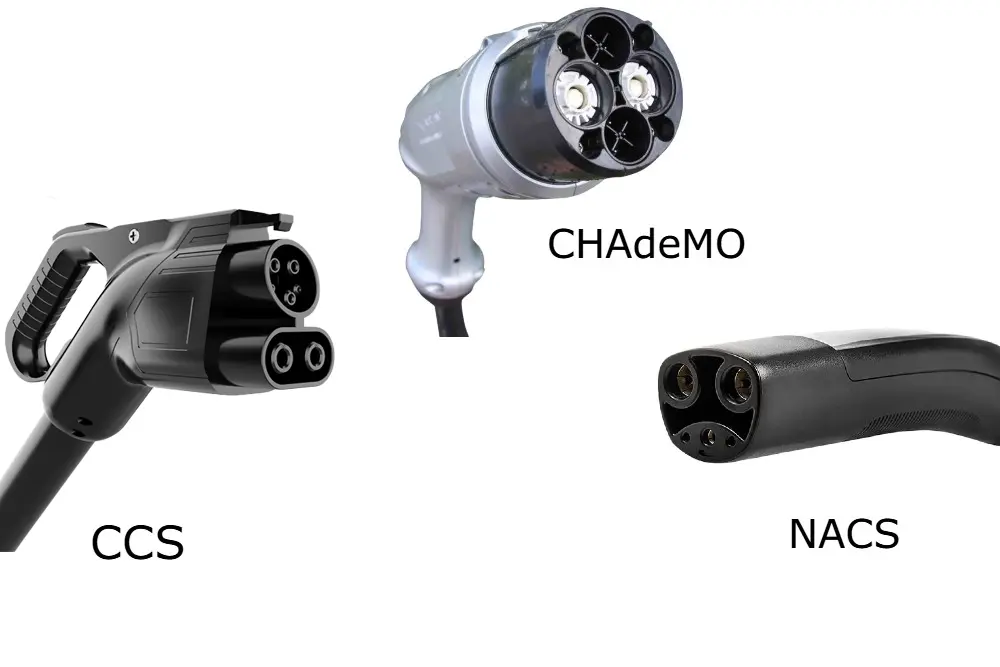
The Combined Charging System (CCS) emerged earlier as a collaborative effort among major global automakers and industry organizations seeking a universal fast-charging solution.
Originally developed in Europe by manufacturers such as BMW, Daimler, and Volkswagen, the CCS standard was later adopted by American automakers including General Motors and Ford. Its goal was to create a unified system capable of supporting both AC and DC charging through a single vehicle port.
The CCS design builds upon the existing J1772 AC charging connector widely used in North America. To enable fast charging, engineers added two large DC pins beneath the original five-pin AC interface.
This configuration created what is known as CCS1, the North American version of the Combined Charging System.
Key characteristics of CCS include:
- Compatibility with existing AC charging infrastructure
- Support for high-power DC fast charging
- Broad support from global automakers
- Integration with many public charging networks
For years, CCS served as the dominant fast-charging connector among non-Tesla electric vehicles in North America.
One of the most visible differences between NACS and CCS lies in their physical design and ease of use.
Tesla engineered the NACS connector with simplicity and ergonomics in mind. Compared with other charging plugs, it is significantly smaller and lighter, making it easier to handle during daily charging.
The compact design offers several advantages:
- One-handed operation
- Reduced physical effort when plugging in
- Improved usability in tight parking spaces
- Easier handling during bad weather conditions
Because the same connector handles both AC and DC charging, drivers do not need to worry about switching between different plug types. This simplified interface contributes to a more intuitive charging experience.
Many EV users consider NACS to be one of the most user-friendly charging connectors currently available.
The CCS connector, while highly functional, is considerably larger and heavier than the NACS plug. This is primarily due to its two-part design that combines the J1772 AC connector with an additional DC charging section.
As a result, CCS cables tend to be thicker and less flexible, especially at high-power fast-charging stations. Some drivers report that plugging in CCS connectors can require more effort, particularly in cold weather when cables become stiff.
Despite these usability challenges, CCS connectors remain widely deployed across many global charging networks.
Charging speed is one of the most important factors influencing EV adoption. Drivers want fast charging that minimizes downtime during long trips.
Tesla's Supercharger network currently delivers up to 250 kilowatts (kW) of charging power through the NACS connector.
Under optimal conditions, this allows compatible vehicles to gain approximately 200 miles of driving range in around 15 minutes.
While 250 kW is already highly competitive, the NACS standard was designed with future scalability in mind. The specification theoretically supports up to 1 megawatt (MW) of DC charging power, which could become important for heavy-duty vehicles such as electric trucks.
This forward-looking design makes NACS adaptable for the next generation of EV technology.
The CCS charging standard supports even higher theoretical power levels in current deployments.
Modern CCS charging stations can deliver up to 350 kW, with systems capable of operating at up to 1,000 volts.
High-performance EVs designed to take advantage of these capabilities include models such as the Lucid Air, which can accept charging rates approaching 300 kW under ideal conditions.
However, real-world charging performance depends on several variables:
- Vehicle battery temperature
- State of charge
- Charger availability
- Network performance
As a result, actual charging speeds often vary regardless of the connector standard.
Infrastructure plays a crucial role in determining the success of any charging standard.
One of the greatest advantages of NACS is its integration with the Tesla Supercharger network.
Tesla has spent more than a decade building one of the most reliable and extensive fast-charging networks in North America. These stations are strategically located along highways, urban areas, and key travel routes.
Key benefits of the Supercharger network include:
- High reliability
- Integrated vehicle navigation
- Fast payment and authentication systems
- Consistent charging performance
Because the network was designed specifically for Tesla vehicles, it historically offered a seamless user experience.
However, Tesla has begun opening portions of the network to non-Tesla EVs, particularly as more automakers adopt the NACS connector.
CCS charging infrastructure is distributed across multiple independent providers rather than a single vertically integrated system.
Major CCS network operators include:
- Electrify America
- ChargePoint
- EVgo
This decentralized model has both advantages and disadvantages. While it encourages competition and rapid network expansion, it can also lead to inconsistent reliability and varying user experiences across different stations.
Nonetheless, CCS networks continue to grow rapidly, supported by government incentives and industry investment.
Industry support often determines which technological standards ultimately succeed.
In recent years, several major automakers have announced plans to adopt the NACS charging connector for future electric vehicles sold in North America.
Companies making this transition include:
- Ford Motor Company
- General Motors
- Rivian
- Volvo Cars
These decisions reflect growing confidence in the NACS ecosystem and the benefits of access to Tesla's charging infrastructure.
For consumers, this shift could significantly simplify the EV charging landscape by reducing the number of competing standards.
Despite the momentum behind NACS in North America, CCS remains widely used worldwide.
In Europe, the CCS2 connector serves as the official fast-charging standard mandated by regulators. Many international automakers continue to design vehicles around CCS compatibility.
As a result, CCS is likely to remain an important charging interface globally even if NACS gains dominance in North America.
Government policies also influence the adoption of charging standards.
In the United States, federal programs aimed at expanding EV infrastructure—including initiatives under the U.S. Department of Energy and national infrastructure legislation—have historically supported CCS compatibility for public charging networks.
However, regulators have begun adapting policies to accommodate the growing industry shift toward NACS connectors.
This regulatory flexibility could accelerate the expansion of NACS-compatible charging stations across the country.
Both NACS and CCS are evolving to support emerging charging technologies.
Future developments may include:
- Ultra-high-power charging systems
- Megawatt-level charging for heavy trucks
- Bidirectional charging for vehicle-to-grid (V2G) applications
- Improved communication protocols between vehicles and chargers
These innovations could further transform the EV charging ecosystem and influence which standard becomes dominant in the long term.
For everyday EV drivers, the NACS versus CCS debate ultimately affects convenience, charging speed, and network accessibility.
Consumers want:
- Simple plug-and-charge experiences
- Reliable charging stations
- Fast charging speeds
- Broad network coverage
As automakers adopt NACS and charging networks expand compatibility, drivers may soon experience a more unified charging system across North America.
The EV charging industry is still evolving rapidly. While CCS once appeared to be the long-term standard in North America, the rapid adoption of NACS by major automakers has dramatically reshaped expectations.
Some industry analysts believe the region could eventually converge on NACS as the primary connector standard. Others argue that both systems will coexist for many years as infrastructure transitions gradually.
Regardless of the outcome, the competition between NACS and CCS is accelerating innovation and improving charging technology for the entire EV market.
The comparison between NACS and CCS represents more than just a technical difference between charging connectors. It reflects a broader transformation in how the EV industry approaches infrastructure, user experience, and technological standardization.
NACS offers a compact, user-friendly design backed by one of the most reliable charging networks in North America. CCS, on the other hand, provides a globally established standard capable of extremely high charging power and supported by a wide range of automakers.
As more companies align with the NACS connector and charging networks adapt to new market realities, the future of EV charging in North America may become increasingly unified.
What remains clear is that both standards have played crucial roles in accelerating the adoption of electric vehicles. Their continued evolution will shape how millions of drivers power their vehicles in the years ahead.