DC Fast Chargers vs AC EV Chargers: Key Differences Explained
As electric vehicle (EV) adoption accelerates worldwide, the need for efficient, reliable, and well-planned charging infrastructure becomes increasingly important. Whether for workplace charging, public networks, commercial fleets, or highway corridors, choosing the right type of charging technology directly affects user convenience, charging cost, and operational efficiency. Among the available options, AC EV chargers and DC fast chargers remain the two most widely used technologies, each designed to serve different scenarios and charging demands.
Although both are essential in the EV charging ecosystem, AC and DC EV chargers operate very differently. Understanding how each type of charger delivers power to an EV—and the advantages and limitations associated with each—is crucial for businesses, property developers, fleet managers, and workplaces planning to expand or upgrade their charging systems. This article provides a detailed comparison between AC and DC EV chargers, explains their technical characteristics, and examines the situations where each charging solution is most effective.
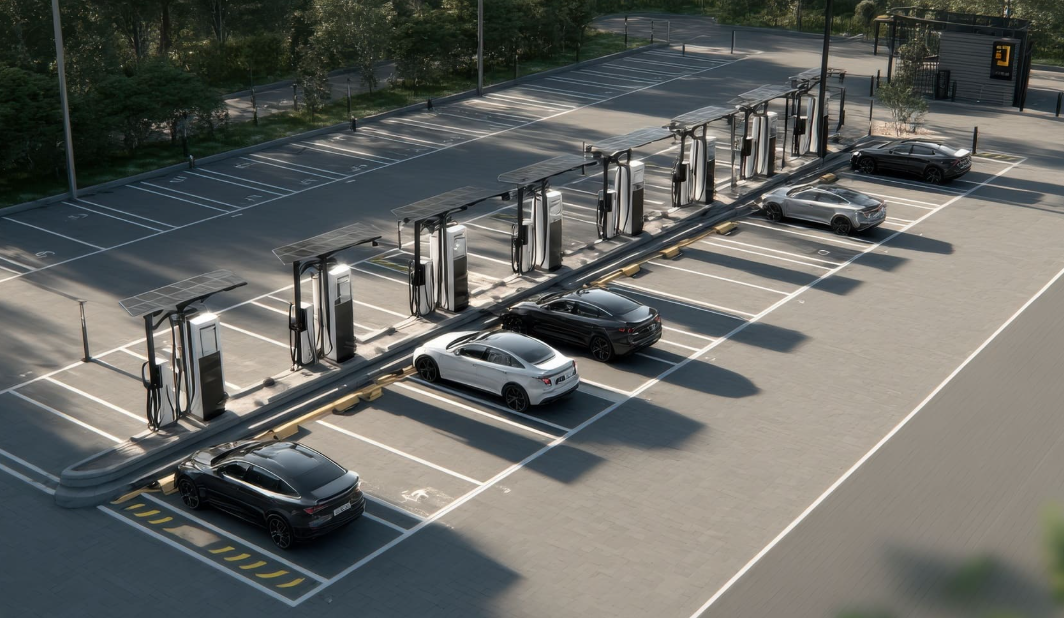
An AC EV charger supplies alternating current (AC) to the electric vehicle. However, EV batteries can only store direct current (DC). This means AC chargers rely on the vehicle’s onboard AC-to-DC converter, a built-in module that transforms incoming AC into battery-compatible DC energy. Because onboard converters have limited capacity—typically between 3.3 kW and 22 kW—the charging speed is determined by both the charger’s power rating and the vehicle’s maximum AC charging capability.
For workplace environments, AC charging remains the most common and practical solution. Most commercial AC chargers are available in 7 kW (single-phase) or 22 kW (three-phase) configurations, offering efficient overnight or workday charging without imposing extreme demands on electrical infrastructure.
Modern AC chargers also feature:
Compact housings for easy installation in offices and commercial parking areas
Durable structure and protection ratings such as IP65 and IK10
Smart charging management, allowing businesses to monitor energy use and optimize charging schedules
Dual charging options, such as dual-socket AC stations that allow two vehicles to charge at the same time
These features make AC chargers ideal for long-duration parking environments, such as offices, residential complexes, universities, and retail centers.
A DC EV charger supplies direct current directly to the battery, bypassing the EV’s onboard converter entirely. This allows a DC charger to deliver far greater power—typically between 60 kW and 360 kW, with ultra-fast systems exceeding 400 kW in some regions.
Because DC chargers deliver power straight into the battery pack, they are capable of ultra-fast charging, reducing the time needed to reach 80% charge to as little as 15–25 minutes, depending on the EV model and battery management system.
DC chargers are engineered for high-demand environments, featuring:
High protection ratings such as IP54 or IP55
Advanced liquid or forced-air cooling systems
High-power power modules for stable, efficient energy delivery
Multiple output configurations (CCS1, CCS2, CHAdeMO) to support various EV standards
These heavy-duty chargers are typically installed at public charging stations, inter-city highways, logistics hubs, bus depots, ride-sharing fleet centers, and high-turnover commercial sites that require rapid energy replenishment.
The most fundamental difference lies in where the AC-to-DC power conversion happens:
Charger Type | Where AC Converts to DC | Typical Power Range | Charging Time |
AC Charger | Inside the vehicle (onboard converter) | 3.3 kW – 22 kW | Several hours |
DC Charger | Inside the charger (offboard conversion) | 60 kW – 360 kW+ | 15–45 minutes |
Because onboard converters are smaller and limited in capacity, AC charging is slower. DC chargers, with their large power modules, can deliver significantly higher power directly to the battery.
AC charging represents the backbone of the EV charging ecosystem. Most EV owners rely on AC charging at home, workplaces, or public parking lots where vehicles remain parked for extended periods. Since AC chargers do not require expensive power modules or heavy electrical upgrades, they remain cost-effective and easy to install.
AC chargers can be connected to standard household outlets, commercial electrical systems, or standalone AC wall boxes. Their lower power requirements mean they can be installed in nearly any building with minimal modifications.
Because AC chargers do not include high-power DC conversion hardware, they are significantly cheaper—in both equipment cost and installation cost—compared with DC fast chargers. This makes AC charging attractive for:
Offices
Residential communities
Hotels
Shopping centers
Schools
Operating costs are also low, since AC charging draws moderate power from the grid.
Slower charging is gentler on EV batteries. Regular AC charging results in:
Reduced heat generation
Lower stress on battery cells
Prolonged battery life
This makes AC charging ideal for daily, routine use.
Despite its advantages, AC charging has several limitations:
Depending on charger power and battery size, AC charging may require 4 to 10 hours to fully recharge an EV. This makes it unsuitable for quick stops or fast turnarounds.
Even if you install a 22 kW AC station, the actual charging speed depends on the EV’s onboard AC converter. Many EVs can only accept 7 kW to 11 kW, restricting maximum AC charging speed.
Businesses that need rapid vehicle turnover—such as delivery fleets or public stations—may find AC chargers too slow to meet operational needs.
DC Charging: Speed Meets Convenience
DC fast chargers are designed for situations where charging speed is critical. Instead of relying on the onboard AC charger, DC stations include their own power modules, delivering high-power DC electricity directly into the battery.
Many modern DC chargers can replenish an EV battery from 10% to 80% in approximately 18–25 minutes, depending on the model. Some high-end systems can reach even faster times under optimal conditions.
This speed is essential for:
Highway rest stops
Commercial fleets
Taxi and ride-hailing services
Logistics and delivery companies
High-traffic public stations
DC fast chargers allow EV drivers to quickly recharge while:
Traveling long distances
Running errands
Stopping for coffee or a meal
This reduces range anxiety and enables EVs to function much like traditional gasoline vehicles in terms of refueling convenience.
DC chargers come in a wide range of power levels:
60–120 kW for small to medium commercial sites
150–240 kW for mainstream public charging
300–360 kW+ for ultra-fast charging and large EV batteries
Megawatt chargers emerging for heavy-duty trucks
This scalability allows businesses to select systems that match their expected traffic and power availability.
Despite the numerous benefits, DC fast charging has notable drawbacks:
Compared with AC charging, DC chargers are substantially more expensive due to:
High-power rectifiers
Cooling systems
Larger electrical infrastructure requirements
Grid upgrades
Public charging stations often charge higher rates per kWh to offset these expenses.
Frequent DC fast charging generates more heat and stress within the battery, which may accelerate wear if used excessively. Modern EVs include advanced battery management systems to minimize damage, but regular high-speed charging still affects long-term battery longevity.
One of the most important differences between AC and DC charging comes down to cost.
Low equipment cost
Affordable installation
Lower electricity demand
Ideal for long-duration parking
High upfront investment
Complex power connection requirements
Higher operational expenses
Suitable only for situations where speed outweighs cost
If your workplace or commercial site offers long-term parking—such as 8-hour workdays—AC chargers are typically the most economical and logical option.
AC chargers are generally the preferred choice for most office environments because:
Employees park for long periods
Charging can occur slowly throughout the day
Infrastructure upgrades are minimal
Costs remain low for employers
Dual-socket AC chargers allow two vehicles to charge simultaneously, maximizing space efficiency.
DC fast chargers may be suitable for:
Corporate fleets needing quick turnaround
Logistics companies operating EV delivery vans
Businesses where vehicles constantly rotate throughout the day
High-profile corporate headquarters offering premium charging experiences
In these cases, the speed advantage outweighs the higher cost.
For residential charging, AC charging is almost always the preferred option. Fast charging at home is not only unnecessary but also expensive due to required electrical upgrades and local utility regulations.
Most EV owners find that overnight AC charging fully meets daily driving needs.
AC EV chargers and DC fast chargers each play vital roles in the modern EV ecosystem. AC charging remains the backbone of residential and workplace charging, offering cost-effective installation, ease of use, and battery-friendly operation. DC charging, on the other hand, delivers speed and convenience for long-distance travel, commercial fleets, and high-turnover environments where rapid fueling is essential.
Choosing between AC and DC charging depends on:
The required charging speed
Installation budget
Available electrical infrastructure
User behavior and parking duration
Operational goals and traffic patterns
By understanding the strengths and limitations of each charging type, businesses and property owners can design a charging infrastructure that aligns with user needs and supports the transition toward sustainable electric mobility.