Dual Home EV Chargers: The Smart Charging Solution for Multi-EV Households
As electric vehicles (EVs) rapidly become a mainstream choice for consumers worldwide, home charging infrastructure is evolving to meet new demands. What was once a simple question—“Do I need a home EV charger?”—has now become more complex, especially for households owning more than one electric vehicle. In response to this growing need, dual home EV chargers have emerged as an efficient, cost-effective, and future-ready solution.
A dual home EV charger allows two electric vehicles to charge simultaneously from a single charging unit. Instead of installing two separate chargers, homeowners can use one integrated system that intelligently manages power distribution. This technology is particularly appealing to families with multiple EVs, households planning to purchase a second EV, or properties with limited electrical capacity.
This article explores what dual home EV chargers are, how they work, their benefits, technical considerations, installation requirements, safety features, cost factors, and future trends—helping homeowners make informed decisions about smarter home charging.
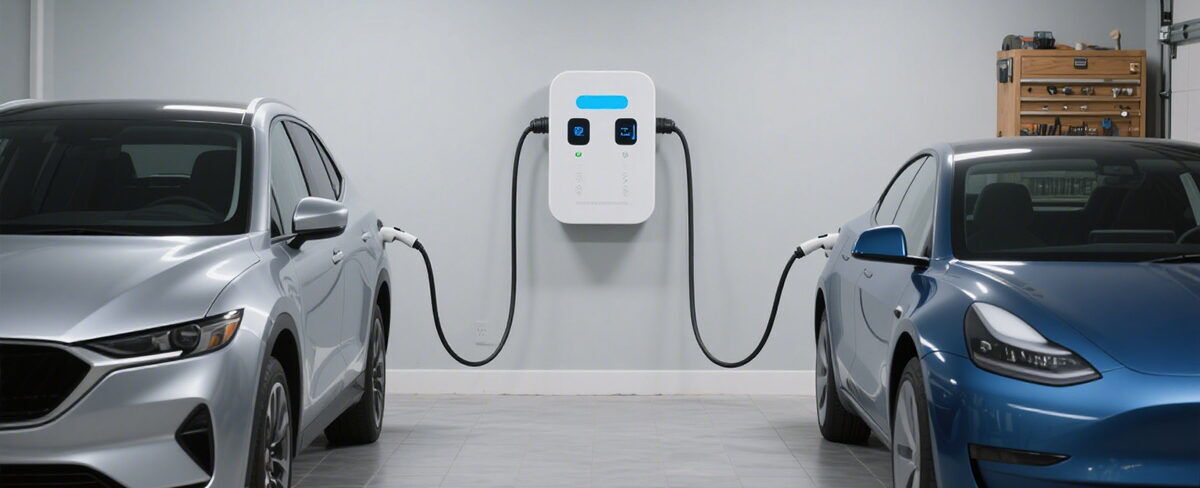
A dual home EV charger is a charging station equipped with two charging ports, enabling two electric vehicles to charge at the same time. These chargers are typically Level 2 chargers, operating on 240V AC power, and are designed for residential use.
Unlike commercial dual chargers found in public parking areas, home dual chargers focus on compact design, intelligent power management, and ease of use. They can either:
Split available power equally between two vehicles, or
Dynamically allocate power based on charging demand, vehicle status, or user-defined priorities
Dual chargers are available with two tethered cables, or one tethered cable and one socket, depending on regional standards and homeowner preferences.
With EV adoption accelerating, many households now own—or plan to own—more than one electric vehicle. Couples may each drive an EV, or families may have a mix of electric cars and plug-in hybrids. Installing a single-port charger often becomes inconvenient, forcing drivers to take turns charging overnight.
A dual charger eliminates this issue by enabling simultaneous charging, improving convenience and reducing scheduling conflicts.
Even if a household currently owns only one EV, installing a dual charger prepares the home for future needs. As EV prices decline and model availability increases, second EV ownership is becoming more common. A dual charger avoids the need for future upgrades or additional installations.
In many homes, electrical capacity is limited. Installing two separate Level 2 chargers may require costly electrical panel upgrades. Dual chargers are designed with load balancing technology, allowing two vehicles to share available power safely without overloading the home’s electrical system.
The core technology behind dual home EV chargers is intelligent power management. Instead of drawing maximum power for each vehicle simultaneously, the charger monitors:
- Total available electrical capacity
- Real-time charging demand of each vehicle
- Household power consumption
Based on these inputs, the charger dynamically adjusts output. For example:
- If only one vehicle is charging, it receives full power
- When a second vehicle plugs in, power is split evenly or prioritized based on settings
- If household electricity usage spikes, charging power can be reduced automatically
This ensures safe operation while maximizing charging efficiency.
Most dual home EV chargers offer total power ratings between 7 kW and 22 kW, depending on regional electrical standards and installation conditions.
7–11 kW dual chargers are common in single-phase residential systems
22 kW dual chargers are possible in homes with three-phase power
When two vehicles are charging simultaneously, each typically receives half the available power. While this may slightly increase charging time, overnight charging still easily meets daily driving needs for most users.
In practical terms, a dual charger can add:
25–40 miles of range per hour when charging one vehicle
12–20 miles of range per hour per vehicle when charging two EVs
This makes dual chargers ideal for overnight charging, even for households with high daily mileage.
The most obvious benefit is convenience. Two drivers can plug in their vehicles without coordinating schedules or unplugging cables. This is especially valuable for busy households where vehicles return home at different times.
Installing one dual charger is often more cost-effective than installing two separate single chargers. Homeowners can save on:
Electrical wiring
Installation labor
Circuit breakers and protection devices
Additionally, many regions offer incentives or rebates for EV charging installations, which may apply equally to dual chargers.
Dual chargers take up less wall or garage space compared to two individual units. This is particularly important for smaller garages, carports, or shared parking areas.
Many dual chargers integrate smart features such as:
Dynamic load balancing
Scheduled charging
Off-peak electricity optimization
Integration with home energy management systems
These features help reduce electricity costs and improve overall energy efficiency.
Modern dual home EV chargers are often equipped with Wi-Fi or Ethernet connectivity, allowing users to control charging via smartphone apps. Common app features include:
- Real-time charging status for both vehicles
- Power allocation control
- Charging schedules
- Energy consumption reports
For homeowners with solar panels or home battery systems, dual chargers can integrate seamlessly. Charging can be prioritized when solar generation is high, reducing reliance on grid electricity and lowering energy bills.
Safety is a critical consideration for any high-power electrical device, and dual home EV chargers are designed to meet strict standards.
Built-In Safety Protections
Typical safety features include:
- Overcurrent protection
- Overvoltage and undervoltage protection
- Ground fault detection
- Temperature monitoring
- Automatic shutdown in case of fault
- Compliance with International Standards
Quality dual chargers comply with standards such as:
- IEC 61851
- IEC 62196
- UL and CE certifications
- Local electrical codes
These certifications ensure reliable and safe operation under residential conditions.
Before installation, a qualified electrician should assess the home’s electrical system to determine:
Available amperage
Single-phase or three-phase supply
Panel capacity
In many cases, a dual charger can be installed without upgrading the main panel, thanks to load management features.
Dual home EV chargers are available in weatherproof designs suitable for both indoor garages and outdoor installations. Look for chargers with IP54 or higher protection ratings for outdoor use.
The price of a dual home EV charger typically ranges from $800 to $2,500, depending on power rating, smart features, and brand.
Installation costs vary based on wiring distance, electrical upgrades, and local labor rates. On average, homeowners can expect installation costs between $500 and $1,500.
Despite higher upfront costs compared to single chargers, dual chargers often offer better long-term value by avoiding future installations and improving energy efficiency.
Dual home EV chargers are ideal for:
- Households with two or more EVs
- Families planning to buy a second EV
- Homes with limited electrical capacity
- EV owners seeking future-proof charging solutions
They are especially beneficial in suburban homes, shared driveways, and residential communities with growing EV adoption.
| Feature | Dual Charger | Two Single Chargers |
| Installation cost | Lower | Higher |
| Space required | Less | More |
| Load management | Integrated | Separate |
| Scalability | High | Limited |
| Convenience | Excellent | Moderate |
As EV technology evolves, dual home chargers are expected to become even more advanced. Future developments may include:
AI-driven energy optimization
Vehicle-to-home (V2H) compatibility
Enhanced solar and battery integration
Faster charging with improved grid coordination
These advancements will further strengthen the role of dual chargers in smart home ecosystems.
Dual home EV chargers represent a practical and forward-looking solution for modern households embracing electric mobility. By allowing two vehicles to charge simultaneously while intelligently managing power, these chargers offer unmatched convenience, efficiency, and value.
As multi-EV households become increasingly common, dual home EV chargers are no longer a niche product—they are a smart investment in sustainable transportation and home energy management. Whether for current needs or future planning, installing a dual home EV charger is a decisive step toward a more flexible, efficient, and EV-ready home.